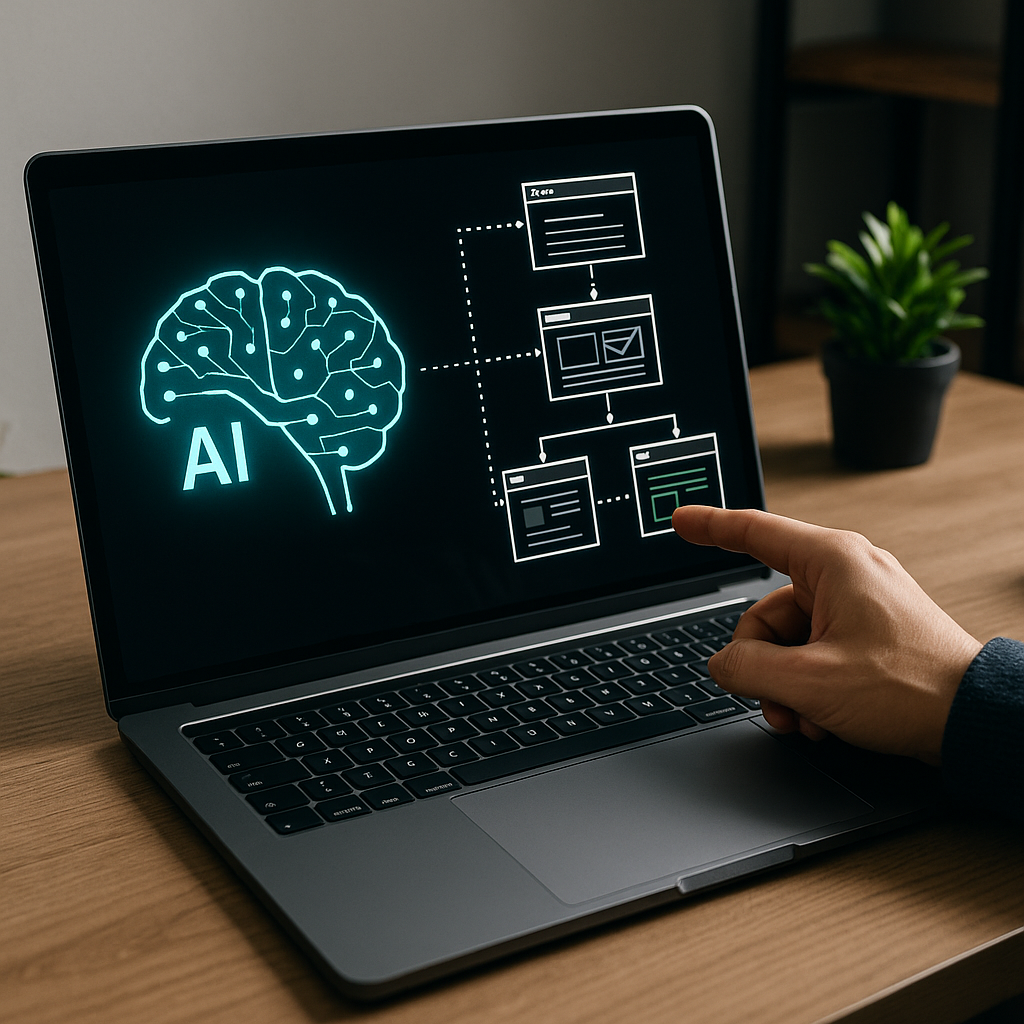
A high-performing website doesn't just rely on its design or content. The way it's organized plays a decisive role in visitors' ability to navigate easily and find the information they're looking for. Artificial intelligence is profoundly transforming this organization by enabling the analysis of behaviors, anticipation of expectations, and continuous adjustment of pages. The result: more intuitive navigation and better overall performance.
By combining data analysis, automation, and continuous learning, AI-based tools offer concrete solutions to make a website more readable, faster, and more efficient. Each user interaction becomes a source of improvement, allowing for the optimization of the overall site structure without relying solely on assumptions.
To understand the role of AI in organizing a website.
Artificial intelligence acts as an advanced observer capable of processing a large amount of data in real time. It analyzes user journeys, identifies friction points, and highlights areas where users drop off. This fine-grained analysis capability allows for adjusting the page hierarchy and rethinking navigation paths.
Unlike a classic approach, based on spot tests, AI offers continuous adaptation. It detects emerging trends and automatically adjusts certain elements, such as menus or internal links. The site thus becomes evolutionary, capable of adapting to real behaviors rather than assumptions.
An intelligent reading of behaviors
Thanks to the collected data, the AI identifies the most frequent actions: clicks, time spent on a page, navigation between sections. It identifies effective paths and those that pose problems, thus allowing for the optimization of information flow.
For example, if a key page is rarely reached, AI can suggest making it more accessible. Conversely, if certain pages generate a lot of interactions, they can be highlighted in the overall structure.
Improve navigation for a smooth experience
A well-structured site must allow the user to quickly find what they are looking for. Artificial intelligence helps simplify this navigation by reducing unnecessary steps. It promotes more direct and logical paths, which improves visitor satisfaction.
Dynamic menus, for example, can be adjusted based on user behavior. A regular visitor will not necessarily see the same suggestions as a newcomer. This personalization strengthens navigation efficiency and limits drop-offs.
Optimized navigation paths
AI can recommend precise modifications to improve site navigation:
- Reorganization of main categories
- Adding relevant internal links
- Simplifying complex menus
- Highlighting strategic content
These adjustments help create a more natural experience, where each click feels obvious. The visitor progresses effortlessly, which increases the chances of conversion.
A question about this article?
Contact usStrengthen consistency between content and structure
An effective website relies on consistency between its pages and their organization. Artificial intelligence allows these elements to be aligned by analyzing the themes addressed and their relevance. It identifies complementary content and proposes logical connections between them.
This approach not only improves navigation but also the overall understanding of the site by search engines. A clear structure facilitates indexing and strengthens the visibility of important pages.
To go further in this logic, certain solutions combine semantic analysis and automation. This is notably the case for AI-driven content strategies, which allow for the optimization of both page creation and organization.
The impact on natural referencing
A well-thought-out structure plays a key role in search engine performance. Artificial intelligence helps improve this by facilitating page exploration by bots. It optimizes how content is linked together, which enhances its visibility.
By analyzing the behavior of indexing robots, some solutions go even further. They adapt the site's structure to precisely meet the expectations of search engines. This advanced interaction allows for better results in terms of positioning.
Innovative approaches like direct communication between robots and the site illustrate this evolution. By facilitating exchanges with search engines, they contribute to a better understanding of content and more efficient indexing.
Better exploration of pages
AI helps to strategically structure internal links, avoiding orphaned or hard-to-access pages. Each page becomes connected to a coherent whole, which improves bot crawling and the distribution of internal popularity.
This organization strengthens the overall relevance of the site and promotes its positioning on targeted queries.
Adapt the continuous structure using data
One of the great advantages of artificial intelligence lies in its ability to constantly evolve. Unlike a one-off overhaul, it allows for continuous improvement. The site adapts in real-time to user behavior, which guarantees lasting performance.
The collected data is used to test different configurations and identify the most effective ones. This approach often relies on automated tests, which allow for quick adjustments to certain elements. Decisions are thus based on concrete results, not on assumptions.
To better understand these developments, it is useful to consult analyses such as the impact of artificial intelligence on SEO, which highlight the ongoing transformations.
Towards a more intuitive and performant experience
Artificial intelligence is redefining how websites are designed and organized. It doesn't just optimize isolated elements: it acts on the entire user journey. Every detail is adjusted to make navigation smoother, faster and more relevant.
By combining data analysis, automation, and continuous adaptation, it makes it possible to create sites capable of meeting visitors' expectations while improving their visibility. The structure becomes a strategic lever, serving overall performance.
Adopting these technologies means choosing a scalable site, capable of continuous improvement. And in an increasingly competitive digital environment, this adaptability makes all the difference.